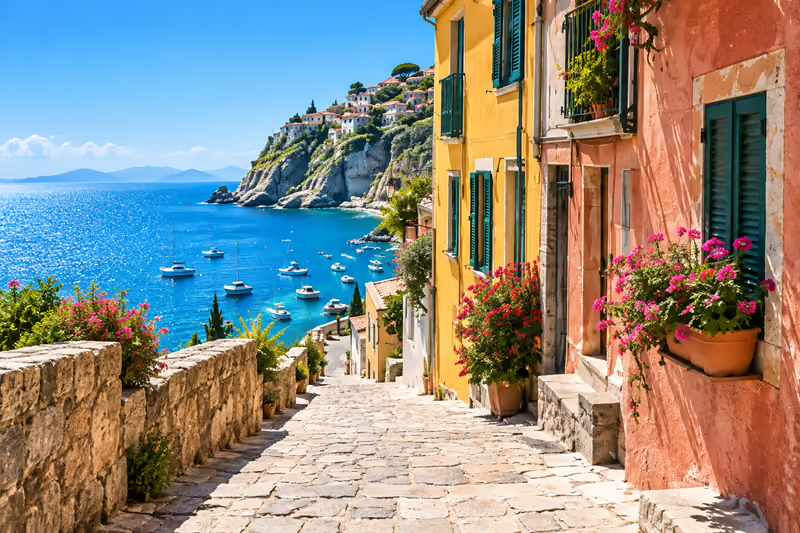
Video Quiz is the closest thing here to a real-footage guessing game. A walking-tour clip plays, you get four countries to pick from, and the points on offer tick down the longer you watch. There is no sign-up and no timer to configure. It draws from 212 hand-checked clips filmed in 54 countries, and we host every one of them ourselves, so nothing on screen names the place before you have guessed it.
How Video Quiz works
Each round starts a short clip, muted, showing a first-person walk through a real place. Four country names sit below it. Your job is to work out where you are from what is actually in frame: the architecture, the signs, the plants, the light. The round is worth 100 points when it starts and decays to nothing over about twenty seconds, so a fast confident guess beats a slow careful one. That tension is the whole game.
Nothing on the page leaks the answer early. The clips are trimmed files we host ourselves rather than embedded players, so there is no video title, no channel name and no suggested-videos grid to read while you think. Even the file names are neutral. An earlier build stored clips in folders named after the country, which handed the answer to anyone who opened the browser network tab, and that was fixed before the current player shipped.
Want the same puzzle without a clock? Flag Quiz, Map Quiz and Capital Quiz are all untimed, so you can sit on a question as long as you like.
Reading a clip fast: the clues that actually narrow it down
A handful of cues do most of the work. They are worth learning in rough order of speed, because the clock, not the difficulty, is the real opponent in a twenty-second round.
Which side of the road the traffic is on is the fastest cut you can make. One passing car settles it. Roughly a quarter of the world drives on the left, so the split is uneven, which makes it most useful for separating answers that otherwise look alike: Ireland and the United Kingdom against continental Europe, or Japan and Singapore against their neighbours.
Road markings and street furniture come next. They are far more distinctive than people expect. Line colour is the obvious tell, with yellow centre lines common across the Americas and white far more usual in Europe, but the paint is only the start. Look at kerb stones, bollards, the shape of pedestrian crossings, and whether the traffic lights hang overhead or stand at the kerb.
The writing system, before the language. You rarely need to read a shop sign. Recognising the script alone narrows the map enormously: Cyrillic, Greek, Arabic, Hebrew, Thai, Devanagari, Han characters, Hangul, Kana. Inside Latin script the diacritics do the same job at a smaller scale. A run of č, š and ž points at central Europe or the Balkans, ą and ł at Poland, ă and ș at Romania, å and ö at Scandinavia, ç and ğ at Turkey.
Vegetation and the light. Palms, olive trees, birch, plane trees lining a boulevard: each has a range, and that range is often tighter than anything you could guess from architecture alone. The light works the same way, only slower. Harsh overhead tropical sun looks nothing like the long low light of a northern latitude. It is a good tie-breaker when two plausible answers are left.
Number plates are the last resort, not the first. A legible plate is rare in a moving shot, but when one does hold still, the shape, the colour of the band down the side and the country letters on it end the round on the spot.
Architecture is the clue most players reach for first. It is genuinely useful and it is also the one most likely to mislead, because building materials, roof pitch, balcony style and street width vary by region rather than by country. Treat it as a way to pick the right continent. Then let the smaller details above choose between the four options you were actually given.
Which side of the road the traffic drives on
Road markings, kerbs, crossings and traffic-light design
The writing system first, then the diacritics inside Latin script
Trees and plants, then the angle and hardness of the light
A number plate's shape and country band, when one holds still
How this compares to a city guesser game
If you have played a city guesser, the format will feel familiar. The question is deliberately different. A city guesser drops you into footage and asks what city am I in, which rewards knowing individual streets and landmarks, while Video Quiz asks for the country and gives you four options rather than an open answer box.
That choice is what makes it playable in a spare two minutes. You do not need to have been somewhere to place it, because reading the script on a shop front or the colour of the road markings is a skill that generalises, while recognising one specific square is knowledge you either have or you do not. It also keeps rounds fair. The wrong answers come from the same region as the right one, so a clip filmed in the Baltics offers other European countries and never a random continent.
The trade-off is real. Video Quiz will not satisfy you if you want to pin a location to the street, and for that, the alternatives we compared are a better fit. Map Quiz is the mode here that asks you to point at a place rather than name it.
Where the clips come from
Every clip is a trimmed excerpt from a freely licensed travel or walking-tour video. None of it is ours. We host the trimmed files ourselves rather than embedding anyone's player, which is a change from how this mode first launched: it used to show YouTube's embedded player, cropped to hide the video title and channel name, because both regularly gave the answer away.
The licences are what let us do that. Every source video carries a Creative Commons attribution licence, which permits trimming and redistribution as long as the creator is credited. The largest single contributor is POPtravel, CC BY 3.0, whose city walks make up a substantial share of the current library. Every other clip names its own creator and licence.
Attribution is a licence condition, not a courtesy. So it is built into the game rather than buried in a footer: the results screen lists a credit for every clip you were actually shown, with a link back to the original, and the full library is on the clip credits page. Neither is reachable mid-round, on purpose. A creator's own video title often spells out the city, so showing credits during a round would simply hand over the answer.
How a round works here
A session is ten rounds. They are drawn from the 212-clip library with no repeats inside a single game, and the wrong answers come from countries in the same region as the correct one, so the round tests recognition rather than elimination. A correct guess banks whatever the ticking score happened to be at the moment you answered. A miss reveals the right country and banks nothing. It never ends the session early.
Then you get the results screen. It is the same one the other three games use: your total, your accuracy, whether you beat your saved best, a review list of what you missed with the correct country next to it, and a credit line for every clip you saw.
Your best score is saved locally. It lives in your own browser, exactly as in the other three games, which is why clearing your site data resets it and why the score does not follow you to another device. The privacy policy sets out what that local storage does and does not touch.
212 clips filmed in 54 countries. A session draws ten countries at random and then one clip from each, so no country, clip or source video ever comes up twice in the same game, and a country with a lot of clips is no likelier to be asked than one with a single clip. The library grows in batches as more freely licensed footage is cleared.
Does the video give away the country before I guess?
No. The clips are files we host ourselves rather than an embedded player, so there is no video title, channel name or suggested-videos grid on screen. Credits appear only on the results screen after the game, and the file names carry no country code.
Is this a city guesser? Does it ask what city am I in?
It asks for the country, not the city, and gives you four options instead of an open answer box. If you want to name the exact city, a dedicated city guesser is a closer fit; this is built to be winnable from general clues in about twenty seconds.
Whose videos are these, and are they used legally?
They belong to the original creators and are used under Creative Commons attribution licences, which allow trimming and redistribution with credit. POPtravel, CC BY 3.0, is the largest single contributor. Every clip's creator and licence is listed on the clip credits page.
Why is the sound muted?
Deliberately. Narration and street noise often name the place outright, so the game reads as a purely visual puzzle. There is nothing to hear even if you unmute your device.
Do I need an account to play or to save my score?
No. Like every other WorldQuizr game, Video Quiz needs no sign-up, and your best score is saved in your browser's local storage rather than tied to an account.
Your next stop
Prefer a calmer, untimed game?
Flag Quiz, Map Quiz and Capital Quiz all have no ticking clock.